

Fundamental analysis of stocks is the process serious investors use before putting even a single rupee into any company. Many of us started investing in the stock market just out of excitement – some buzz about a stock giving 20% returns, a hot tip from a friend, or a trending stock we saw on Facebook, Twitter, or other social media platforms. We might have seen some success initially, which made us overconfident, but then one bad investment made us regret everything.
You or someone you know might have gone through this.
There are many investors who are able to build wealth consistently in the stock market, and they are common people just like us. They are not extra smart; instead, they simply follow a process for stock selection. Before putting even a single rupee into any stock, they ask themselves: Do I really understand this business?
This guide will help you understand how to analyse a company before investing in the same way serious investors do it. Whether you’re browsing stocks on the NSE or scanning the Sensex constituents, these principles work everywhere.
What Does Buying a Stock Actually Mean?
When you buy shares of a company, you’re buying a small ownership stake in a real business. Your money grows when the business grows. You earn in two ways:
- Capital appreciation — the stock price rises as the company becomes more valuable.
- Dividends — the company shares a portion of its profits with you.
But stock prices don’t move solely based on the profits a company earns. They’re driven by expectations, what investors believe the company will earn in the future etc. That’s why fundamental analysis of stocks is important. You need to judge whether today’s price is justified by the business’s actual potential.
Step 1: Start With Understanding How the Business Makes Money
The first step in fundamental analysis of stocks is simple — before you start looking at a single ratio or financial chart, you should ask yourself: How does this company actually earn revenue?
Every business has a business model which serves as a way of creating value for customers and capturing some of that value as profit. A consumer goods company like Hindustan Unilever earns by selling everyday products through their huge retail networks. An IT firm like Infosys earns through long term service contracts with global clients. These are fundamentally different businesses with different risk profiles.
When studying a company’s business model, ask:
Does it solve any existing problem? What problem does it solve, and is that problem still relevant five years from now?
Who are its customers? are they individuals, businesses, or governments?
Is revenue recurring (subscriptions, long-term contracts) or one-time?
How dependent is it on a handful of large clients?
Companies with predictable, recurring revenue and diverse customer bases are generally more stable. That stability matters when markets get rough.
Step 2: Next Look at the Industry It Operates In
A great management team in a dying industry is of no use.
Industry analysis is a critical part of fundamental analysis of stocks. It helps you understand whether the company is getting support or facing challenges. Things you can check:
Is the industry growing?
Sectors like renewable energy, digital infrastructure, specialty chemicals, and healthcare are growing fast and show no signs of stopping. Companies in these areas can grow without needing to outcompete others.
How competitive is it?
Brutal competition destroys margins. When ten companies are fighting for the same customers on price, nobody wins — except the customer. You can look for industries where competition is manageable and where the companies can charge what they want.
Are there strong barriers to entry?
High entry barriers — like regulatory approvals in pharma, capital requirements in infrastructure, or proprietary technology — protect existing players from being threatened by new entrants. That’s a good sign for long-term profitability.
Step 3: Check Is the Business Actually Expanding?
Fundamental analysis of stocks also means checking if the business is actually expanding. Ultimately, a business has to sell more to grow. If a company isn’t growing its sales over time, there’s a limit on how much its profits can grow.
Look at revenue trends over at least five to ten years. A single good year means nothing. What you should look for is consistent, sustained growth across different economic conditions.
Ask yourself these questions:
Is growth accelerating or slowing down?
Is it coming from volume increases (more customers, more units sold) or just price hikes?
Has the company grown through acquisitions? If yes, is that growth sustainable organically?
The most long lasting growth comes from genuine expansion in demand and not accounting tricks or lucky bets.
Step 4: Revenue Means Nothing Without Margins in Fundamental Analysis of Stocks
A company can grow its revenue and still lose value. Margins tell you how much of each rupee in sales actually ends up as profit.
There are three margins you should track:
1. Gross Margin- This shows profitability after taking into account the direct production costs. High gross margins typically signal pricing power or cost efficiency — both of which are competitive strengths.
2. Operating Margin- It shows how much profit a company makes from its core business after salaries, marketing, rent, and other operational costs. This reflects how efficiently the business is being run day-to-day.
3. Net Profit MarginIt is the profit percentage a company keeps after deducting all expenses including interest on debt and taxes. Expanding margins are a positive signal. Margins that are consistently compressing despite revenue growth suggest that there is a deeper problem in the business.
Step 5: Key Ratios in Fundamental Analysis of Stocks
Ratios help you compare companies within the same sector and evaluate them against their own historical performance.
1. Price-to-Earnings Ratio (P/E)- Compares the stock price to earnings per share. A high P/E suggests the market expects strong future growth. A low P/E might indicate undervaluation — or that the market knows something you don’t. Always interpret P/E in context.
2. Return on Equity (ROE)- Measures how efficiently the company uses shareholder money to generate profits. A consistently high ROE say, above 15–20% over several years often tell about the quality of the business.
3. Debt-to-Equity Ratio- It’s a measure of how much the company has borrowed relative to shareholder equity. Some debt is fine. Excessive debt increases risk, especially when interest rates rise or earnings fall.
Step 6: Next Go through the Balance Sheet
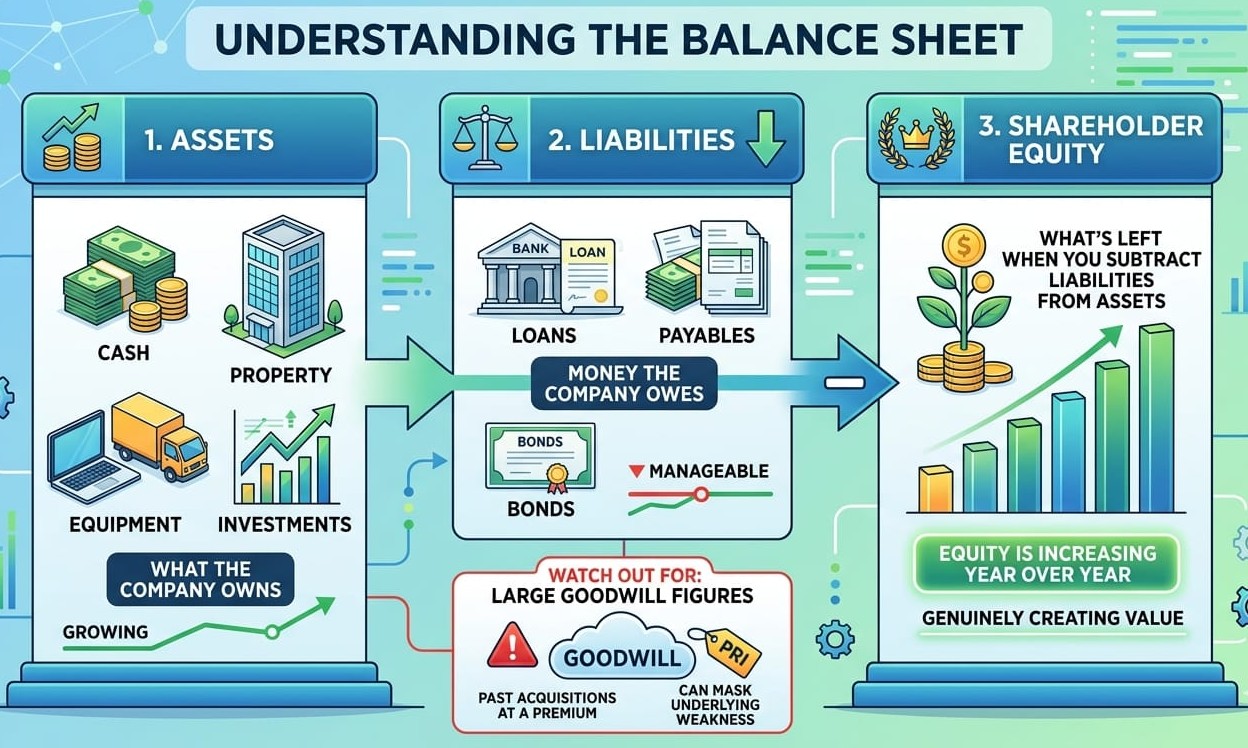
In fundamental analysis of stocks, the balance sheet is an important document. The balance sheet is a summary of what a company owns and owes at a given point in time.
1. Assets: This include Cash, property, equipment, investments that is all those things the company owns
2. Liabilities: It includes Loans, payables, bonds, in short, money the company owes
3. Shareholder Equity: What’s left when you subtract liabilities from assets
It’s great if: assets are growing, liabilities are manageable, and equity is increasing year over year. Growing equity is one of the clearest signs that a company is genuinely creating value.
Watch out for companies with large goodwill figures on their balance sheet, this often reflects past acquisitions made at a premium, and it can mask underlying weakness.
Step 7: Check the Cash Flow
In fundamental analysis of stocks, cash flow is considered more reliable than reported profits. You can manipulate profits but you can’t manipulate cash. Experienced investors pay attention to the cash flow along with other factors.
- Operating Cash Flow- This is the cash generated from the core business. If this is consistently positive and growing, then it’s a strong sign that the business model is good.
- Free Cash Flow- This is operating cash flow minus capital expenditures. This is the money the company can use to pay dividends, reduce debt, fund expansion, or buy back shares. If profits look strong but free cash flow is negative, then you should be careful.
Step 8: Management Quality Matters in Fundamental Analysis of Stocks

Numbers will tell you the past but the management will decide what to do with those figures. Management can make or break a company.
Check:
1. Track record: Has leadership delivered consistent revenue and profit growth over multiple years, not just one good cycle?
2. Capital allocation: What does management do with profits? Companies that reinvest into high-return projects, rather than preferring acquisitions or vanity projects, tend to grow money faster overtime.
3. Corporate governance: Read annual reports. Are disclosures clear and transparent? Is the management candid about challenges? Companies that bury bad news in footnotes are rarely the ones you want to own long-term. In India, governance quality varies a lot across listed companies, so more attention should be paid here.
Step 9: Identify the Competitive Advantage (or Moat)
Warren Buffett popularised the concept of the “economic moat”. This is the unique selling proposition of the company, something which gives them an edge over the competitors. Identifying the competitive moat is one of the most important parts of fundamental analysis of stocks.
Common moats include:
- Brand strength: Consumers prefer this product even at a higher price (Example Asian Paints or Titan).
- Cost advantage: The company produces at a lower cost than competitors.
- Network effects: The product becomes more valuable as more people use it.
- Switching costs: Customers find it difficult or expensive to switch to a competitor.
- Distribution scale: A vast distribution network that takes years and capital to replicate.
A company without a USP faces constant competition and thus its survival becomes difficult. A company with a strong moat can grow consistently over a period of time.
Step 10: Value the Stock to check whether the Price is Justified.

People make this mistake all the time. They find a solid company, get excited, and just buy it without thinking about the price. But when a stock is already trading at a high valuation, all that future growth is already taken into account. One disappointing result and the price drops sharply.
Stock valuation is the final but most crucial step in fundamental analysis of stocks. Common valuation approaches:
- P/E ratio compared to historical averages and industry peers.
- Price-to-Book (P/B) ratio which is useful for asset-heavy industries.
- Discounted Cash Flow (DCF) which estimates intrinsic value based on projected future cash flows.
No valuation method is perfect. You need not mathematically calculate the exact valuation of a stock, you just need to understand whether it is under valued or fairly valued or over valued.
Common Mistakes to Avoid in Fundamental Analysis of Stocks
Many investors skip fundamental analysis of stocks and end up paying a heavy price. Here are the most common ones.
1. Chasing hype: Social media and news cycles create FOMO. Stocks that are everywhere in the news are often already overpriced by the time retail investors arrive.
2. Skipping the financials: Annual reports are publicly available. Investing significant capital in a company whose financial statements you’ve never read is just stupidity.
3. Overpaying for growth: Fast-growing companies deserve premium valuations — but there’s a limit. When expectations get irrational, even great businesses become risky investments.
4. Ignoring debt: A profitable company drowning in debt can collapse quickly if conditions change.
Conclusion: Why Fundamental Analysis of Stocks Matters
This complete guide to fundamental analysis of stocks gives you a proven framework. Understanding and analyzing a stock takes time and you need to be patient as well. But it’s the only way to invest with genuine conviction rather than hope.
The framework here — business model, industry, revenue growth, margins, ratios, balance sheet, cash flow, management, competitive advantage, valuation — gives you a complete picture of any company before you commit your money.
You don’t need to be a chartered accountant or a finance professional to do this. You need patience, curiosity, and the discipline to follow a process even when a stock is tempting everyone around you.
India’s equity markets have created enormous wealth for long-term, informed investors. The stock market has plenty of opportunities, but it can go wrong quickly if you don’t know what you’re doing. If you truly understand what you’re investing in, your risk goes down.
Disclaimer: Investments in securities market are subject to market risks, read all the related documents carefully before investing.
The companies, sectors, stocks or financial instruments mentioned in this article are used purely for educational and illustrative purposes to help readers understand financial concepts. They should not be considered as investment advice, stock recommendations, or a solicitation to buy, sell, or hold any security.
For regular personal finance related updates follow us on Facebook and Instagram
For any queries do Contact Us