

In 2016, the National Payments Corporation of India (NPCI) introduced the Unified Payments Interface (UPI) which brought a major change in India’s financial system. Unified Payment Interface improved the way people send and receive money. It allows its users to link all their bank accounts to a single mobile application, thereby making money transfers faster, simpler, and more secure.
Before the Unified Payment Interface came into the picture, people relied on traditional methods like cheques or electronic fund transfer systems such as Real-Time Gross Settlement (RTGS), National Electronic Funds Transfer (NEFT), and Immediate Payment Service (IMPS). These systems worked, but they were inconvenient. You often had to visit the bank, pay certain fees, and sometimes wait up to three working days for your payment to get cleared.
UPI became popular because of the convenience it offers. Now you no longer need to visit a bank branch or fill out multiple long forms, a single mobile app can now handle almost everything from sending and receiving money to recharging your mobile phone, paying utility bills, and even clearing credit card dues.
But is UPI really the answer to all your daily payment needs? Or is there a hidden side to Unified Payment Interface that most of us ignore? In this article, we will explore how UPI gained popularity among common masses and why you should not be making it your sole payment method.
UPI usage over the years
- In FY 2021-22 the total transaction volume was around 45 billion with a value of ₹84 lakh crore.
- In FY 2022-23 the volume was estimated close to 83 billion with a value nearly ₹139 lakh crore which is close to 82% volume growth over previous year.
- In FY 2023-24 the transaction volume was around 131 billion with a value of ₹200 lakh crore with 57% volume growth over last year.
- In FY 2024-25 estimated transaction volume was 185 billion with a value of close to ₹260 trillion , a 42% volume growth from previous year.
These numbers are really surprising, but they do make sense when you take a closer look at the circumstances that led to UPI’s popularity.
India has become one of the biggest mobile data consumers in the world. An average Indian today uses around 21 GB of data every month. The real reason behind this jump is simple, data in India is super affordable. We’re among the top 10 countries where 1GB of mobile data costs the least, making it easy for almost everyone to stay connected.
What stands out is how much this digital shift has touched our everyday life. Nearly 85% of Indian households now have at least one smartphone. Programs like Jan Dhan Yojana have helped people in rural areas open bank accounts and join the banking system.
From farmers in small villages to street vendors in cities, UPI has made payments fast, easy, and completely cashless.
Commonly used UPI apps
Here are some of the most widely used apps:
- PhonePe: It was launched in August 2016, and managed to on-board over 600 million+ registered users as of 2025. Phonepe also has the highest market share in terms of UPI volume, approximately 47-48% in 2025. Its market share grew from a few millions in 2016 to hundreds of millions of users by 2025..
- Google Pay (India): It was originally launched as “Tez” in September 2017. The market share of Google pay by UPI volume is estimated at around 35-37% in 2025. Despite entering the market later than its competitors, it adapted fast.
- Paytm: Paytm started as a mobile wallet, they later integrated UPI in 2016. Paytm has over 500 million registered users as of 2025 according to various sources. In terms of volume, market share of Paytm is estimated to be around 6-11% in 2025, which is quite low bearing in mind that it was one of the early players in the race.
- BHIM UPI: Launched December 2016 by National Payments Corporation of India (NPCI) as official UPI app. While its still in use with 70-75 million monthly transactions in June 2025, its growth is slower as compared to private apps.
What Makes UPI So Convenient?
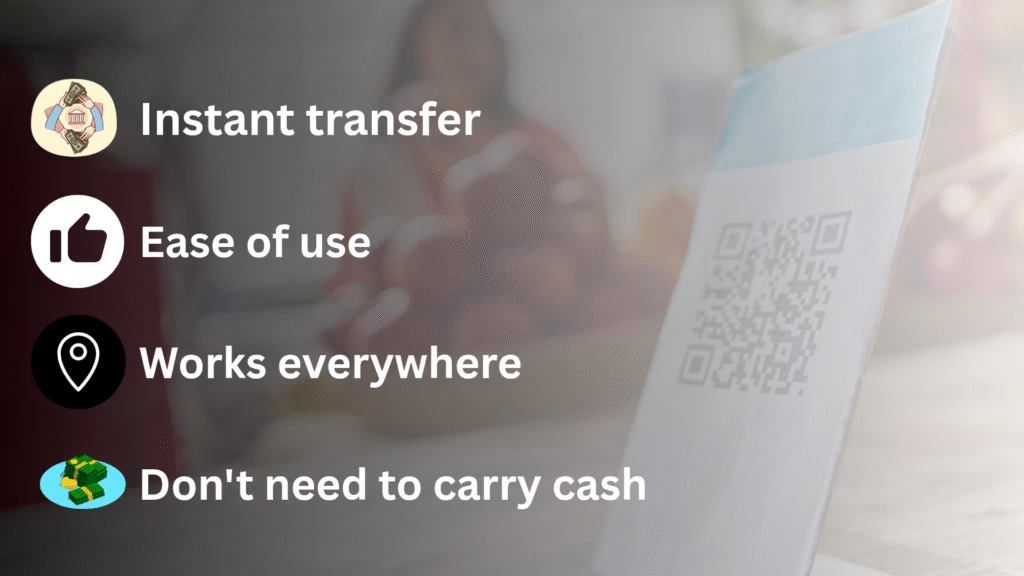
UPI has simplified digital transactions like never before. Here’s why people love it:
- Instant Transfers – Money can be transferred from one bank account to another within seconds. There is no need to wait for bank hours or cheque clearances.
- Ease of Use – Because of apps like Google Pay, PhonePe, Paytm, and BHIM, even those who are not very comfortable with banking technology can transfer money with minimal effort.
- Works Everywhere – From daily transport payments to personal transfers, UPI works at almost all merchants that accept digital payments.
- No Cash Needed – You don’t have to carry physical cash anymore, which makes everyday payments cleaner and safer.
Example – Lets say that you are at a wedding, and your cousin asks for Rs 500 to contribute to the catering. Wouldn’t UPI be incredibly helpful in such situations?
Is UPI Really Secure?
UPI apps are built with strong security features like two-factor authentication, bank-level encryption, and fraud detection systems. Still, risks remain, mostly due to human error rather than technology flaws.
Common Security Risks:
- Phishing Scams: Fraudsters often call claiming to be bank officials and ask for OTPs. Sharing these can result in instant loss of money.
- Fake QR Codes: Scammers sometimes stick fake QR codes over genuine ones, directing payments to their accounts.
- Device Vulnerabilities: Lost or stolen phones with logged-in UPI apps can be exploited if app locks and OTP alerts are not enabled
Tip: Always cross-check the recipient’s name, check transaction alerts, and avoid sharing OTPs or PINs.
Real-Life Examples
Example- Ramesh runs a tea stall. Earlier, he used to struggle with change and was worried about keeping cash safe. After he started using UPI for transactions, his daily routine changed. Customers completed payments in seconds, due to this his sales increased during rush hours, and Ramesh could now focus more on serving tea than handling money.
Example- Sandeep receives a call from a stranger who sounds genuine and a little stressed. “Sir, I made a mistake,” the caller says. “I accidentally sent ₹2,000 to your UPI account. Can you please send it back? I really need the money.” Sandeep opens his UPI app to check. There is no new credit in his account. When he tells the caller this, the caller says that sometimes credit transaction in UPI don’t show instantly. Sandeep decides to trust the caller and sends the money back.Soon after, he receives a link on his phone. The caller asks him to use the link to “refund” the amount. Sandeep follows the instructions and enters his UPI PIN. Immediately, ₹2,000 is deducted from his account. He waits for the money that the caller claim was sent earlier, but it never comes. That’s when he realizes that he made a mistake.
If someone claims they sent money to you by mistake, don’t panic or respond immediately, check your bank account first. Wait until the amount gets credited in your bank account.Don’t click on unknown links or share your UPI PIN, no matter how urgent the request sounds. If the money isn’t showing in your bank account then there is no need to take any action. Also remember that UPI never requires a PIN to receive money.
UPI has made payments quick and convenient, but a small mistake or a hurry can lead to financial loss.
UPI’s Future in India
UPI is evolving rapidly. NPCI data shows that in 2025, India processed over 19 billion UPI transactions per month, this shows the growth story of UPI and how people have embraced the technology. With innovations like UPI AutoPay, recurring payments, and integration with international cards, its utility is only growing.
Technology makes payments easier, but it doesn’t remove the need to be careful. Understanding the risks and using UPI responsibly is just as important as being cautious with cash or credit cards.
Is UPI Really free of cost?
UPI is generally free for users under normal usage. Many apps even offer rewards or cashback after performing certain transactions. However, it should be noted that certain platforms may charge small fees for specific services provided by them, such as mobile recharges. While users generally don’t pay extra charges right now, merchants may be charged depending on the transaction value.
These are a few things users should be mindful of.
UPI works really well. It is fast, simple, and convenient, and in most situations, it can be considered as a reliable method of payment. The issue doesn’t lie with the system itself but with how careless it is often used.
In the 1970s and 80s, most households depended on a single earning member and had more people to support. Despite that, many families managed their expenses carefully. Today, households often have multiple earning members and smaller family sizes, still saving for retirement has become more difficult. Inflation plays a role, but it isn’t the only reason. Unplanned spending is another major factor.
Before digital payments became common, people usually relied heavily on cash for their daily and monthly expenses. This naturally encouraged planning. Cash creates a sense of awareness as you can actually see and feel the money leaving your hands.
With UPI, that sense of money being spent is missing. Payments happen instantly, without any physical reminder. It’s common to see people using UPI even for very small amounts, sometimes as little as ₹5. That doesn’t seem significant. But these small payments add up quickly—₹5 becomes ₹10, then ₹50—and before you realize, your monthly budget is exceeded. Because each transaction feels small, many people don’t bother tracking them at all.
At the end of the day
UPI has become a part of everyday life, and that is not necessarily a bad thing. The issue is how we use it.
- Don’t use it for micro transactions. It becomes difficult to keep a track of multiple small transactions. Try to use cash for essential expenses. For example; groceries, rent, fuel. Use UPI if it’s absolutely necessary.
- Always be cautious while doing digital transactions. UPI fraud mostly happens due to user mistakes, not system failure. Acting in a hurry or panic increases the risk of losing money. Users should always verify credits before responding to any payment request.
- Clicking unknown links or following phone instructions can lead to fraud. Financial awareness is as important as technological advancement. Screenshots or SMS messages claiming payment are not proof of a real credit.
Use UPI as an alternative, don’t make it your sole payment method.
For regular personal finance related updates do follow us on Instagram and Facebook
For any queries Contact Us