

A financially secure future starts with proper financial planning. This new year could be the perfect time to start building a financially brighter future. Let’s begin the year with a small resolution to create wealth through simple and easy steps.
Financial planning is not only for finance experts, it is for everyone who earns and spends money. Whether you are a salaried employee, freelancer, business owner, or student, having a proper financial plan can completely change how secure and stress-free your future feels.
Financial planning is about knowing where your money comes from, where it goes, and how to make it work for you. This guide will walk you through all aspects of financial planning, from saving and investing to insurance and long-term goals in a practical and easy to understand way.
What Is Financial Planning?
Financial planning is the process of setting financial goals and creating a roadmap to achieve them. It includes:
- Managing income and expenses
- Building savings
- Investing wisely
- Protecting yourself with insurance
- Planning for retirement
- And emergencies
Good financial planning helps you live comfortably today without compromising your future.
Step 1: Understand Your Income and Expenses
Before saving or investing, you should have a clear idea of your sources of income, how frequently you receive it (weekly or monthly), and how much money you actually have. To understand your income and expenses you need to track your cash flow by asking yourself these questions:
- How much do I earn every month?
- How much do I spend?
- Where is my money leaking from?
Now You Can Create a Simple Budget by dividing Your Expenses Into:
Fixed expenses – There are some expenses that stay mostly the same every month and are difficult to avoid, regardless of your lifestyle choices. This includes expenses such as rent, EMIs, groceries, electricity bills, and school fees. These are necessities.
Variable expenses – Some expenses change from month to month and depend largely on your lifestyle and choices, they are called variable expenses. Variable expenses include expenses on food, travel, and shopping.
Discretionary expenses – These are expenses that are optional and not essential for daily living. You can reduce or completely avoid without affecting your basic needs. In simple terms, these are “nice-to-have” expenses.
Tip: Even small expenses matter. Tracking them helps you stay in control.
Step 2: Build the Habit of Saving
Saving is the foundation of financial planning. Why Saving Is Important? In times of emergency, your savings will help reduce your financial stress. Without savings, you may end up falling into a debt trap.

You May be Curious on How Much People Should Save. One Popular Guideline is the 50–30–20 Rule:
50% for needs – Includes expenses that you cannot avoid.
30% for wants – These are lifestyle-related expenses. These can be adjusted, and even a small reduction of 5% can make a difference in the long run.
20% for investments – This depends on your goals, but 20% is often considered a good balance.
For some people, even saving 20% may feel difficult. That’s perfectly okay. You can start small and gradually increase your savings over time. Even investing ₹1,000 a month is better than not starting at all.
Step 3: Create an Emergency Fund (This is Non-Negotiable)
Multiple surveys suggest that close to 75% of Indians lack an emergency fund. This means that in case of job loss, medical emergencies, or sudden expenses, many people are vulnerable to debt and financial stress. This is one the biggest reason to have an proper financial planning.

Ideal Emergency Fund Size
In an ideal financial planning scenario, you should aim to keep at least 3 to 6 months of expenses as an emergency fund. Self-employed individuals may need to save more. Rather than keeping this money in your savings bank account you can keep this money in:
- Low-risk and liquid mutual funds
- Fixed deposits, which can also be a good option—just be aware of the lock-in period
- Avoid equity or stock-related investments for emergency funds
If you want to know more about emergency fund you can check How to Build an Emergency Fund in India (2025 Guide for Beginners).
Step 4: Insurance – Protection Before Investment
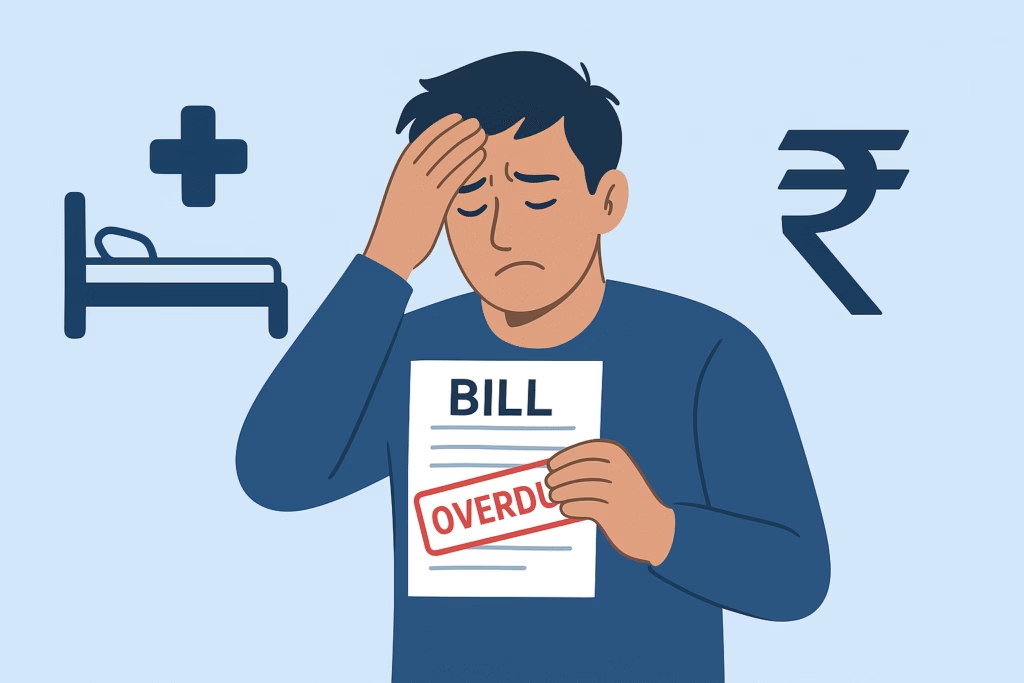
According to NITI Aayog, nearly 30% of India’s population does not have proper health insurance.Why Health Insurance Is Critical?
In India, the average cost of a heart surgery is around ₹2 lakh, which is close to what many individuals earn in a year. This makes insurance an absolute necessity, as people can be just one emergency away from financial trouble. Insurance also protects your financial plan from unexpected shocks.
Types of Insurance You Must Have
Health Insurance : Always choose a pure health insurance plan that covers you and, if possible, your family members’ medical expenses. It helps prevent your savings from getting wiped out. Remember to choose adequate coverage, not just the cheapest plan.
Term Life Insurance : Term insurance provides a high sum assured at a relatively low premium and is essential if you have dependents. It ensures financial security for your family. Do not expect any returns from term insurance, it is meant purely for protection, not investment. Avoid ULIPs or money-back policies, as they usually have higher premiums and lower coverage compared to term insurance.
Note : Insurance is not for returns; it’s for peace of mind.
Step 5: Investing – Making Money Work for You
Saving alone is not enough. Investing helps you beat inflation and grow your wealth over time. Before you start investing, it is very important to have clear goals in mind. Setting goals gives you clarity and purpose. It also helps you decide how much to invest and for how long. Clear goals encourage disciplined investing and make it easier to track your progress. This small step can make a big difference.
Your investment goals may include:
- Buying a house
- Children’s education
- Retirement
- Wealth creation
Types of Investments
There are different investment options for different goals.
Bank Fixed Deposit (FD)
Bank FDs are traditional form of investment where you can deposit a lump sum amount with a bank for a fixed period and get a guaranteed interest. They are regulated, low-risk, and provide capital safety with guaranteed returns. Bank FDs are most suitable for risk-averse investors, senior citizens, and short term goals like saving for travel, a down payment etc. They are not ideal for beating inflation, but they are excellent for stability and financial certainty.
Corporate Fixed Deposit (Corporate FD)
Corporate FDs are fixed deposits offered by companies instead of banks. These deposits usually provide higher interest rates but they carry more risk than bank FDs because returns depend on the company’s financial health. These are suitable for slightly risk aware investors who want better fixed income and are investing for 1–3 year goals. They tend to be safest when high credit-rated, well-established companies are selected. They are not recommended for emergency funds, but can work well for fixed return portfolio diversification.
Bonds (Corporate or Government)
Bonds are debt instruments where you lend money to a government or a company and in return you get interest over a period of time. Government bonds are among the safest, while corporate bonds depend on the issuer’s credit quality. Bonds are suitable for investors who are looking for regular income, portfolio balance, or medium- to long-term goals like funding education or generating passive interest income. They are great for reducing equity volatility and adding stability to financial plans.
Recurring Deposit (RD)
RDs allow you to invest a fixed amount every month and get guaranteed interest, like an FD but with monthly contributions. They are perfect for people who want to build a consistent saving habit without taking risk. RDs are suitable for beginners, young earners, and short-term planned goals like buying a laptop, creating a festival fund. They provide safety but limited growth, so they are not suitable for wealth building.
Government Securities (G-Sec)
G-Secs are government bonds issued by the RBI for the Government of India. As they are backed by the government, the risk of default is almost nil. They are a good option for conservative investors who want safety and steady returns over the long term. G-Secs are commonly used for retirement planning, or preserving wealth with low risk. However, they are not ideal if you need quick access to money, unless you sell them in the secondary market.
Treasury Bills (T-Bills)
These are short term government instruments having maturities of 91, 182, or 364 days. They are very liquid, safe, and do not fluctuate like equity. These are appropriate for parking surplus funds, maintaining emergency funds, or managing short-term goals while earning better returns than a savings account. T-Bills are best suited for investors who want safety and liquidity without exposure to equity market volatility.
Gold
Gold can be bought physically or digitally, and also through Gold Mutual Funds and ETFs. It is not an asset meant for chasing high returns but it is a store of value. Gold is best for long term goals like weddings, generational wealth, or protecting against inflation and currency risk. It acts as a hedge when markets fall and works well for portfolio diversification, but it’s not ideal for short-term profit.
Silver
Investing in silver is similar to gold but it is more volatile due to industrial demand influence. It can be purchased physically or via silver ETFs and Silver Mutual Funds. It is suitable for investors who want some commodity exposure and long-term inflation hedge, especially those who believe in future industrial and renewable sector demand. It’s good for diversification, but not for capital that might be needed urgently.
If you are confused about whether to invest in gold or silver, do check our article Gold vs Silver in 2025: Who is the Ultimate Winner?
Real Estate
Real estate includes investing in land, residential or commercial property. It builds wealth slowly and can generate rental income, but lacks liquidity. It suits investors with huge capital and long term goals like retirement, passive income, or legacy building. Real estate is best for those who want tangible assets and regular rental cash flow, but it is not suitable for emergency funds or short term needs.
REITs (Real Estate Investment Trusts)
REITs are exchange listed real estate instruments that allow you to invest in commercial real estate without buying physical property. They offer rental based payouts and market linked price movement. This suits investors who want real estate exposure with passive income and liquidity. It is ideal for small capital investors and portfolio diversification, but returns depend on market cycles.
Employees’ Provident Fund (EPF)
EPF is a government regulated retirement savings scheme for salaried employees, where both you and your employer contribute monthly. It offers compounding, safety, and stable interest. EPF is suitable for individuals who want to start retirement planning early and invest for the long term with low risk. It is not a flexible short term investment option.
Public Provident Fund (PPF)
PPF is a 15 year government backed investment offering tax free returns and high safety. You can contribute yearly or monthly. It suits investors wanting safe long term wealth creation for retirement or children’s education. PPF is ideal for tax efficient compounding and capital safety, but it has a lock in so it’s not for short term goals.
To know more check our article on Is Public Provident Fund (PPF) Still a Good Investment in 2025? Here is the Truth
National Pension System (NPS)
NPS is a market linked retirement scheme regulated by PFRDA, allowing both equity as well as debt exposure in a structured way. It is ideal for investors who want retirement planning with compounding and tax benefits. It is best for disciplined long term goals like pension creation, but not for short term liquidity.
Atal Pension Yojana (APY)
APY is a government pension scheme focused on offering fixed monthly pension post age 60, mainly for low income groups or unorganised sectors. It suits individuals who want guaranteed pension. It’s ideal for basic retirement income security, but not for wealth creation.
National Savings Certificate (NSC)
NSC is a 5 year government savings bond offering fixed interest with 80C tax benefit. It is suitable for conservative investors who want safe tax saving growth for medium term goals. Ideal for capital protection and tax saving, but not for high liquidity needs.
Senior Citizen Savings Scheme (SCSS)
SCSS is a government backed income scheme for individuals aged 60+, offering regular interest payouts. It suits retirees who want safe, predictable income. Ideal for monthly/quarterly passive income, not for long-term aggressive compounding.
Sukanya Samriddhi Yojana (SSY)
SSY is a long term, tax free, government savings scheme exclusively for a girl child. It suits parents planning for education or marriage expenses. Ideal for safe long term goal planning, not for flexibility or withdrawals.
Derivatives (F&O Trading)
Derivatives are exchange traded contracts like Futures and Options, highly volatile and leveraged. They are suitable only for experienced traders or hedging. These are not wealth-building or capital parking instruments.
Unit Linked Insurance Plan (ULIP)
ULIPs combine insurance and market linked investments. They have lock ins and higher costs than term plans or MFs. They suit investors who want long term insurance and investment in a single product. These are ideal for structured long term goals. They are not cost efficient and are not suitable for an emergency funds.
Equity or Stocks (High Growth, Higher Risk)

Investing in stocks may not be ideal for someone who is just starting their investment journey. With over 5,000 stocks listed on the NSE and BSE, picking the right ones is not easy. Equity investments also carry risk, so if you plan to invest directly in stocks, you should consider taking expert advice.
Equity Mutual Funds
Equity mutual funds invest in stocks and do carry risk, but they are managed by professional fund managers on your behalf. These funds are more suitable for long-term wealth creation and should be considered for long-term goals.
Debt Mutual Funds
These are suitable for short-term goals such as emergencies or unplanned expenses. Debt funds usually offer stable returns with lower risk compared to equity.
Hybrid Investment Options
For medium term goals of around 2–3 years, hybrid options may be suitable. You can consider balanced advantage funds or multi-asset allocation funds, which invest in a mix of equity, debt, and assets like gold and silver.
Systematic Investment Plans (SIPs)
If you are a salaried individual or investing in equity for the first time, SIPs can be a good starting point for you. SIPs help build discipline and reduce the risk of poor market timing, making them ideal for beginners.
You can have a look at our article on Different Types of Mutual Funds Explained Simply to check suitability of investment.
Note : it’s not about how much you invest, but how long you stay invested and allow the power of compounding to work for you.
Step 6: Asset Allocation – The Heart of Financial Planning
Asset allocation is one of the most important aspects of financial planning but many people unknowingly ignore it. In quest of higher returns, they often invest heavily in equity and end up taking more risk than they can handle. Asset allocation, as the name suggests, refers to dividing your money across different asset classes. This helps you manage risk during market corrections and gives you exposure to various types of investments.
Let’s understand it in a simple manner. Say all your money is invested in equity. Now as you know equity market does not perform consistently. In some years it may underperform and in such a time if all your money is invested in equity you will be left with nil or negative return. In this situation, if you want your money for some emergency purpose or if your financial goal is due, you may have to withdraw the money at a loss. Instead of putting all your money into one asset class like equity, it is best to divide your money in different asset classes like equity, debt, gold, silver, International equity and others. In this way you can reduce risk and create a balanced portfolio.
Why is Asset Allocation Necessary
- Reduces risk
- Improves consistency
- Protects your portfolio during market volatility
Your asset allocation should depend on :
Age: If you are young, you can usually take more risk and invest a higher portion in equity. As you grow older, it is wise to gradually reduce equity exposure and shift towards more stable asset classes.
Income stability: This is very important. Many people stop their SIPs within two years and miss out on the real power of compounding. Some even book losses during short term market volatility and regret later.
Risk tolerance: It is very important to understand your comfort level with risk before investing. If market ups and downs make you uneasy and scare you, consider allocating more to stable asset classes that are not directly linked to the stock market.
Financial goals: As mentioned earlier, having clear goals helps you stay focused and in control of your investments.
It should be noted that there is no one size fits all approach. Just because your friend’s investments are giving higher returns does not mean you should copy their strategy.
Step 7: Retirement Planning – Start Early, Relax Later
Your retirement may seem far away, but time passes faster than we often realize. Starting early allows your investments to compound over a longer period. Early planning helps because more time means more compounding, and you need a lower monthly investment to reach your retirement goal. If you start planning for retirement early, you can invest a smaller amount each month since your goal is far away and you have a long time horizon.
However, if you start just a few years before retirement, you will need to invest a much higher amount to reach the same goal. This is because you have less time, and the benefit of compounding is limited.
Step 8: Review and Adjust Your Financial Plan
Financial planning is not a onetime activity. Many people say they have been investing for a long time, but that does not mean you should invest and then forget your investments.It’s better to review your investments at least once a year, or after major life events such as marriage, a job change, or the birth of a child. After reviewing you are also expected to make certain adjustments as and when needed.
Review your investments if your income increases, if there is a loss of income, if you face big expenses, or as you grow older. As time passes, it is better to gradually shift towards more stable asset classes.
You should also review your insurance policy every year at the time of renewal. You should make changes to the policy when you plan to start a family, when you feel the current sum assured is insufficient, or when you are diagnosed with a new chronic disease such as hypertension or diabetes. Your financial planning should evolve as your life changes.
Common Financial Planning Mistakes That You Should Avoid
- Investing without clear goals
- Ignoring insurance
- Not having an emergency fund
- Chasing high returns blindly
- Copying others’ investments strategy
Smart financial planning is not a tough complex process but it’s just about discipline, patience, and clarity.
Final Thoughts: Financial Planning gives you Freedom
Financial planning is not about restriction, it is about choice and freedom. It gives you the freedom to handle emergencies and having a financially secure future. Financial planning is having that scene of security and peace of mind.
Disclaimer: investing in securities and securitize debt instruments are subject to market risk, read all scheme related documents carefully before investing.
For regular personal finance related updates do follow us on Instagram and Facebook
For any queries Contact Us